
Source Reference: Watch the original documentary footage here
The Silicon Paddy: Why China’s “Sci-Fi” Farms Are the Real Trade War Nightmare
By [Vjiee] Investigative Analysis | Long Read
Introduction: The Scene That Shouldn’t Exist
Picture a farm for a moment. Close your eyes.
If you grew up on Western media, you likely see a red barn. Perhaps you see a guy named Old McDonald or a family in denim overalls. You imagine dirt under fingernails, sweat, and the rumble of a diesel engine struggling on a cold morning. Basically, a fight against nature.
Now, look at the footage from Manas County, Xinjiang.
It looks like The Martian. But instead of Matt Damon growing potatoes to stay alive, a fleet of faceless machines conquers the earth.
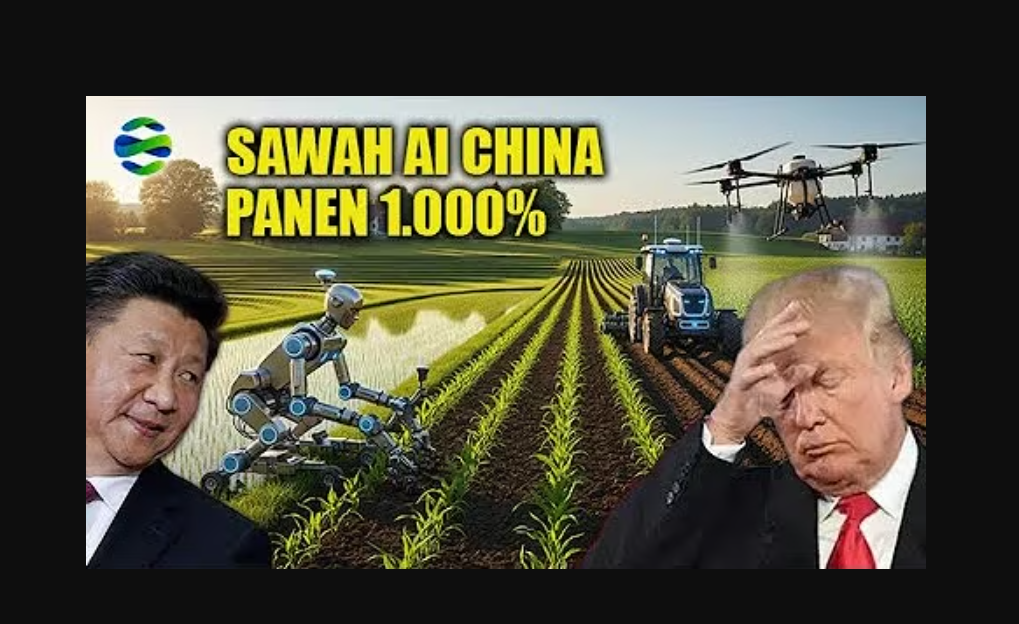
I’ve been obsessing over this video. The title translates to “Trump Gets a Headache! Chinese Ag-Robots and Drones Dominate Rice Fields”.
Clickbait? Maybe. However, clickbait usually doesn’t keep you awake at night.
The video opens on a cotton field so vast the horizon curves. Rolling across it are massive white machines. They look like tractors, but they aren’t. A tractor implies a driver. Furthermore, a tractor implies human choices: “Turn left,” “Slow down,” “Rock ahead.”
In contrast, these machines are ghosts. No drivers. Empty cabs. Some don’t even have cabs; they just have sensors. They move in perfect, terrified unison, guided by something invisible.
This isn’t farming. Effectively, it’s manufacturing. They turned the soil into a factory floor. Consequently, if you sit in Washington or London thinking agriculture is a “legacy industry” compared to microchips, you are wrong. This is the frontline.
I dug deep because I wanted to know why these robots exist, who built them, and what happens when the country with the most mouths to feed fires its farmers.
Part I: The Death of the “Peasant” Myth
Let’s kill the stigma first. For decades, we saw Chinese agriculture as “rustic.” We pictured a peasant in a conical hat, knee-deep in mud, leading a water buffalo. We thought it was inefficient. As a result, it made the West feel superior. “They have factories, sure, but they can’t feed themselves without an army of laborers.”
That arrogance is dangerous.
The Xinjiang footage lights a match to that myth. We see a “super farm” covering 6,667 hectares. That is roughly 16,000 acres. For comparison, an American family farm might be 2,000 acres. This is eight times that size.
Five years ago, managing land that size was a nightmare. You needed an army. Specifically, you needed seasonal laborers, housing, food, pay, supervisors, and mechanics.
Now? You need one guy with a tablet.
The documentary shows five high-power Autonomous Ground Vehicles (AGVs) moving in a phalanx. They don’t just plant seeds. Instead, they run a complex industrial process in a single pass:
- First, they plow the earth to the exact millimeter.
- Simultaneously, they lay drip irrigation lines directly to the root.
- Then, they spread mulch film for protection.
- Finally, they cover the soil.
One pass. No waste. No coffee breaks.
The precision is where the “Sci-Fi” kicks in. Surprisingly, they don’t use GPS.
Part II: Why “GPS” is for Losers (The Beidou Factor)
Here is the tech detail people miss: Beidou.
GPS is American. Owned by the US Air Force. It guides your Uber. It’s accurate to within 3 to 5 meters. That is fine for a car. However, it is a disaster for a robot planting seeds. You’d be planting in the neighbor’s driveway.
China knew relying on American GPS was a trap. The US could turn it off. So, they built Beidou.
They optimized it specifically for this.
Beidou, combined with ground stations, hits an accuracy of 2.5 centimeters.
Look at your thumb. That’s about 2.5 centimeters. These multi-ton monsters drive across mud and stay within a path the width of your thumb.
That’s why the footage looks uncanny. The rows are mathematical. Precision saves money. There are no overlapping rows. No missed spots. They squeeze every calorie out of the dirt.
Part III: The Money Talk (Jiang Jin’s Receipts)
“Cool robots,” you might say. “But does it pay?”
Meet Jiang Jin.
Jiang isn’t a politician. He manages about 300 hectares (740 acres) of cotton and wheat. In the US, he’d be drowning in debt for his combine.
Jiang does the math, and it’s shocking.
Switching to this automated system cut his labor costs by 135 million Indonesian Rupiah (roughly $9,000 USD a fortune in rural China).
But saving money is just the appetizer. The main course is yield.
Before robots: 400 kilograms per unit. After robots: 800 kilograms.
Double. That is 100% growth.
In corporate America, a 3% productivity bump gets a bonus. Jiang got 100%.
Why? Because robots don’t mess up. They don’t plant too deep. They don’t over-water. They fix every variable.
This scares Western competitors. China doesn’t have more land. Rather, they just make their land work twice as hard.
Part IV: The “Cool” Factor (Youth Return)
A slow-motion catastrophe is hitting global farming: The “Silver Tsunami.” Farmers are dying.
The average age of a Japanese farmer is 67. In the US, it is 60. Young people hate farming. It’s hard, dirty, and lonely. One storm can bankrupt you. Why do that when you can code in Shenzhen?
China’s strategy? Rebrand the job.
The documentary shows a new wave of “farmers.” Surprisingly, they look like gamers.
These are university grads returning to the village. The job isn’t “digging holes.” It’s “Fleet Commander.”
Control rooms look like NASA. Banks of monitors. Joysticks. Data streams showing soil pH and wind speed. A guy in a hoodie taps a screen. Immediately, a swarm of drones takes off.
They use XAG drones to spray pesticides. But they don’t spray everything. Cameras spot sick plants. Then, drones spray only those plants.
Chemical use drops 30%. It’s cheaper. It’s cleaner. And a 25-year-old computer science grad actually wants the job.
China gamified agriculture to solve the labor shortage. Meanwhile, American kids leave the farm to become influencers. Chinese kids go back to become Drone Pilots. Who wins that trade in 20 years?
Part V: Terraforming the “Sea of Death”
The Taklamakan Desert segment goes full sci-fi.
Taklamakan means “You go in, you don’t come out.” It is a shifting ocean of sand.
The video shows a 346-kilometer Green Belt choking the desert.
This is engineering. Terraforming.
The method is genius. First, they build massive solar farms. Solar panels generate power. Simultaneously, solar panels cast shade. This shade lowers evaporation.
Under the panels, they plant drought-resistant grass. Consequently, plants hold the sand. Panels protect the plants. Plants stop dust from covering panels.
A closed loop. Energy and food from a wasteland.
Think about the coordination. In the US, a wind turbine project takes five years of lawsuits. China terraformed a desert because the roadmap said so.
Part VI: The Ghost Paddies of Guangxi
The rice paddies in Guangxi are the most unsettling.
Rice is hard. It is wet, muddy, and requires finesse.
The video shows a “fully unmanned” rice farm. Small, agile robots navigate the mud. Not big lumbering beasts. Instead, they are nimble.
They plant seedlings. Then, unmanned harvesters collect the rice. The harvester offloads grain into a driverless truck. They talk wirelessly. “I am full.” “I am here.” They sync, transfer, and move on.
A robot ballet.
This happens in Guangxi, a less developed province. It’s not just Beijing. It’s spreading.
Part VII: The “Trump” Headache (Soy Geopolitics)
Let’s address the title: “Trump.”
Why?
Trump’s trade war woke China up.
For decades, China bought US soybeans. America grew them better. China had factories. It was a fair trade.
Then tariffs hit. Food became a weapon. China realized relying on a rival for dinner was suicide.
The 2027 Roadmap is the result. Beijing set a deadline. Absolute grain security. Feed 1.4 billion people even if the US blockades the ocean.
These drones, these tractors, these desert farms they are the shield.
If China stops buying American soy because they grow their own (or buy from Brazil, or grow in Africa using Chinese tech), the US farm economy crashes. Iowa enters a depression. That is the “headache.” It’s a migraine.
Part VIII: The Verdict
After analyzing the frames, the yields, the deserts… how should we feel?
It’s complicated.
On one hand, as humans on a heating planet, this is awesome. We need this. We need to grow more food with less water. Green the desert? That saves Africa and the Middle East. It is a win for humanity.
But it’s a wake-up call the West ignores.
We argue about climate change reality while China builds solar shade-farms to fix it. We argue about farm labor visas while China builds robots that don’t need visas.
The writing is on the wall.
The farmer of the future wears a headset, not overalls. He programs drones; he doesn’t pray for rain.
And right now, that farmer speaks Mandarin.
Ignore the AI scores. Look at the ground. Steel, silicon, soil. Everything is changing.
Key Takeaways (TL;DR)
- Scale: 16,000-acre farms run by 5 people.
- Tech: Beidou, not GPS. 2.5cm accuracy.
- Yield: 100% output increase.
- Youth: Tech lures pros back to villages.
- Environment: Solar-farming reverses desertification.
- Threat: Decoupling from US food by 2027.
Watch the skies. The drones are there.